What Happened at the Midterms?


Power tends to corrupt, and absolute power corrupts absolutely. The Republican loss on Tuesday night was caused by President Trump’s dreadful misread of a mandate he was given two years ago. He promised no new wars, an end to inflation and the protection of Medicare. Today, a ruthless stalemate between the U.S. and Iran persists, the price of food and fuel continues to surge and 11 million people no longer receive Medicaid.
Trump’s election victory in November 2024 was the result of concerns over the economy, immigration and crime. In December 2023, unauthorized crossings on the U.S.-Mexico border peaked at 249,700. A halt to the construction of Trump’s border wall and the removal of a policy that required non-Mexican asylum seekers to have their cases processed in Mexico fueled the increase. Consequently, Republicans conflated the immigrant crisis with the issue of crime.
Above all, the catastrophic state of the economy increased support for Trump. Due to supply chain shortages created by COVID-19, inflation steadily rose throughout 2021. Higher prices were perpetuated by the Russian invasion of Ukraine. In 2022, the rate of inflation reached a 40-year high of 9.1%. Although the cost-of-living emergency eased, it continued during Biden’s presidency. In anticipation of the 2024 election, 81% of U.S. voters said that the economy would be very important to how they voted.
Trump promised to “make America affordable again.” Using an array of lower taxes, less regulation and extensive tariffs, he also pledged to bring the U.S. to new records of success. His economic policy was condemned by 16 Nobel Prize-winning economists, who warned that the U.S. and world economy would suffer. Nonetheless, Trump directly addressed the concerns of working-class Americans. As a result, he won the 2024 presidential election with 312 Electoral College votes to Kamala Harris’ 226.
Upon assuming the presidency, Trump pursued an inflationary agenda. On April 2, 2025, he introduced a tariff of 10% on virtually every good entering the United States. Additional rates were charged on the nation’s largest trading partners. The “Liberation Day” tariffs increased inflation, reduced economic growth and erased up to $2.5 trillion off the stock market. Next, the Iran War. Due to the closure of the Strait of Hormuz, the price of gas spiked to $4.56 per gallon—up from $3.10 when the president was inaugurated.
In the middle of a president's four-year term, he faces his greatest electoral test. Control of Congress is decided through elections for the entire House of Representatives and one-third of the Senate. Together, these two chambers form the legislative branch of government, which enacts laws, funds federal agencies and holds the White House to account. “Pretend I’m on the ballot,” President Trump urged American voters.
In this article, I’ll explore the results and aftermath of the 2026 midterms.
House of Representatives
At the 2024 elections, Republicans won control of the House of Representatives. Their victory was narrow—they won 220 seats to the Democrats’ 215. The House is composed of 435 members—each representing an area of around 765,000 people called a district. All members are elected through the first-past-the-post system, in which the candidate with the greatest number of votes wins.
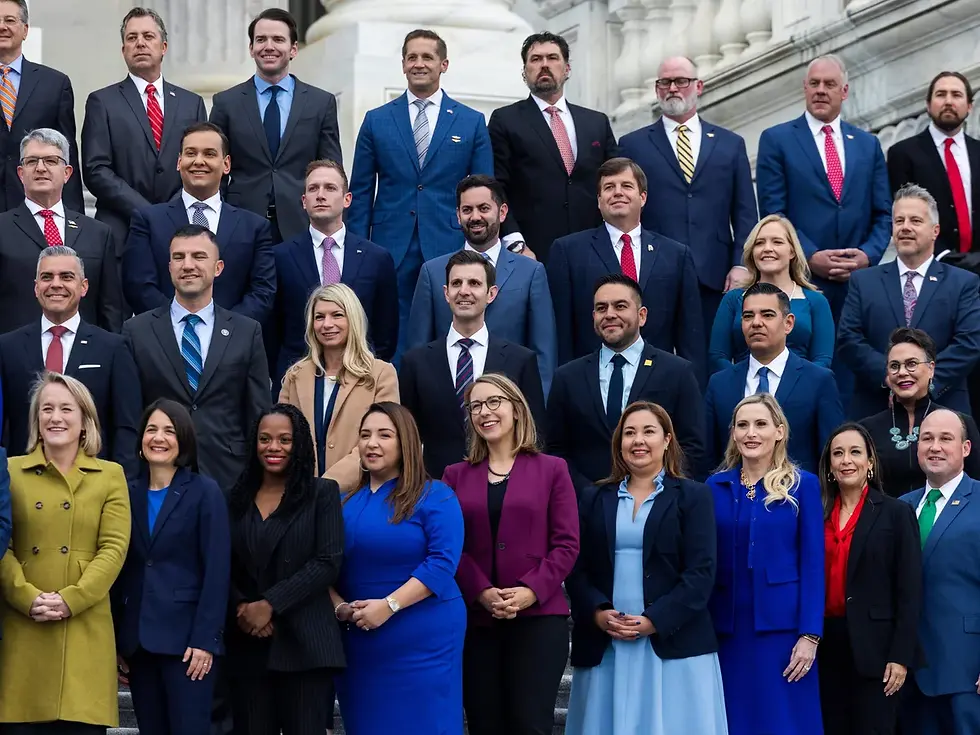
On Tuesday, Democrats won control of the House of Representatives. Their victory was conclusive. Democrats won 254 seats compared to the Grand Old Party’s 162. They are on course for their largest majority in the House since 1990. This means the party’s leader in the House, Hakeem Jeffries, will become Speaker of the House of Representatives. He’ll be the first African American Speaker in the nation’s history.
By popular vote, Democrats won 55% compared to the GOP’s 42%. It’s the party’s largest popular-vote victory since 1974, when Republicans were battling the fallout of President Nixon’s Watergate scandal.
In Arizona’s 6th, Republican Congressman Juan Ciscomani defeated his Democratic opponent by a margin of 2.5 points. On Tuesday, Ciscomani was defeated by 8 points. In Michigan’s 7th, GOP member Tom Barrett was elected with a majority of 3.7 percent. Two years later, he lost to a Democrat by a majority of 3.3 points. In Iowa’s 1st, Republican Congresswoman Marianette Miller-Meeks won by a margin of 0.2 percent. Last week, she trailed a Democrat by 9 points. The three congressional districts share two characteristics. Firstly, an incumbent Republican member of Congress lost their bid for reelection. Secondly, they lost due to the soaring cost of living. From the plains of Iowa to the suburbs of Michigan and deserts of Arizona, voters sent a resounding message to the president.
In the lead-up to the 2026 midterms, an arms race emerged between states run by Democrats and Republicans to redraw the boundaries of congressional districts. In July 2025, President Trump urged Texas to reshape its map to benefit Republicans. This is known as gerrymandering. In response, California redrew its map so Democrats had the advantage. Ultimately, a net of 12 Republican-leaning seats were created, while only 1 Democratic-leaning district was established. Nonetheless, Jeffries’ party is projected to gain 39 seats.
In the first 100 hours in control of Congress, Democrats hope to pass legislation to reverse Medicaid cuts, remove Trump’s tariffs and end the Iran War. In response, President Trump claims he’ll be “Mr. Veto.” Democrats need 60 votes in the Senate and control of the Oval Office to enact this legislation, but they claim it will “show divisions” between them and the GOP on vital issues.
The Senate

In the lead-up to November’s election, Democrats were widely projected to win the House. Statistician Nate Silver gave Jeffries’ party a 96% chance of flipping the chamber. Given the map of Senate seats holding elections, at first the prospect of Democrats gaining the Senate was practically impossible. Increasingly, it became highly likely. In the final week of campaigning, Silver’s model gave Democrats an 80% chance of flipping the chamber.
In 2024, Republicans gained control of the Senate. They won 53 seats, while Democrats won 47. On Tuesday, 33 seats in the chamber were up for grabs. Senators are divided into three “classes,” each elected for a six-year term on rotation every two years. In his capacity as vice president, JD Vance holds the tie-breaking vote. This means Democrats were required to win 51 seats to flip the chamber.
For Democrats, their path to gaining control of the Senate traveled through two states.
In his political career, former Democratic Governor of North Carolina Roy Cooper has never lost an election. Cooper won two gubernatorial elections while Trump won the presidential contest higher on the ballot. In 2025, he left the governorship with widespread support. Months later, Cooper announced his candidacy for the U.S. Senate. On Tuesday, he defeated Republican Michael Whatley by a margin of 20 points. Two years earlier, Trump won the state by 3 percent. The unprecedented scale of the swing toward Cooper demonstrates his talent as a candidate.
Republican Susan Collins is the only senator representing a state won by Harris in 2024. On Tuesday, Collins lost her grip on Maine. Troy Jackson won 53% of the vote to her 46%. Originally, Democrats selected oyster farmer Graham Platner as their candidate. A string of scandals consisting of offensive social media posts damaged his reputation, before an allegation of rape made him withdraw his candidacy. He was replaced by the comparably dull and uncharismatic Jackson. He is the first Democrat to win a U.S. Senate election in Maine since 1988.
Maintaining current seats was equally as important as gaining new ones.
Following Trump’s victory in Georgia in 2024, Democrat Jon Ossoff was destined to be a one-term senator. “Ossoff to top list of at-risk incumbents in 2026,” headlines wrote. In 2020, he won the state by 1.2 points. On Tuesday, Ossoff won by 18 points. The result added to momentum for the potential of a presidential bid by the senator. His charisma resembles that of a young Obama. Ossoff’s ability to comfortably win in a swing state is an ideal asset for Democrats.
Democratic incumbent Gary Peters announced his retirement from the Senate in early 2025. In a tense primary campaign, Abdul El-Sayed faced Haley Stevens for the Democratic nomination for the Senate election in Michigan. El-Sayed represented the progressive wing of his party. Aided by $62 million spent on her behalf, Stevens was a moderate. Ultimately, El-Sayed defeated Stevens by less than one point. In the general election, he faced Republican Mike Rogers. Days before November 3, Stevens endorsed Rogers in a stunning move. Her “October surprise” earned criticism from all factions of the Democratic Party. El-Sayed defeated Rogers by 7 points to become the first Muslim U.S. senator.
Vice President JD Vance was required to resign his Senate seat to enter the administration. As a result, a special election for the U.S. Senate seat from Ohio was held on Tuesday. Sherrod Brown, the Democratic senator from 2007 until 2025, narrowly lost his reelection bid in 2024. Brown stood in the special election. He faced Republican Jon Husted. “I don’t do this with men very often. I started examining his body… I looked at his ass,” Trump remarked about Husted. The comments were another sign of Trump’s decaying mental state. Brown emerged victorious, winning the election by nearly 5 points.
Breakthroughs in uncharted territories were required.
Texas is the jewel in the GOP’s crown. No Democrat has won a statewide election in the Lone Star State since 1994. Until Tuesday. At the beginning of 2026, a tight and feisty Republican primary featured Ken Paxton, the state’s attorney general, to challenge incumbent Senator John Cornyn. Aided by an endorsement from President Trump, Paxton won the primary. Paxton was previously impeached by his own party over charges of bribery, abuse of office and obstruction. Meanwhile, Congresswoman Jasmine Crockett battled seminary student James Talarico for the Democratic nomination. Talarico was selected. He rose to fame following an appearance on Joe Rogan’s podcast and during the resistance against gerrymandering in Texas. Talarico combines his ardent religious beliefs with a progressive agenda of wealth taxes, universal health care and opposition to data centers. Although Trump won Texas by 14 points in 2024, Talarico defeated Paxton by 12 percent. His victory is one for the history books.
In Kansas, a similar story occurred. Democrats selected Adam Hamilton, the pastor of America’s largest Methodist congregation, as their candidate for Senate. Hamilton is a centrist who sees “both sides” of the abortion argument. His opponent was incumbent Republican Senator Roger Marshall. Hamilton defeated Marshall by 5 points. He is the first Democrat to win a U.S. Senate election in Kansas since 1932.
In the Corn Belt state of Iowa, another centrist Democrat defeated the GOP. Josh Turek is a former Paralympic gold medal winner. He was selected as the Democratic candidate for Senate, advocating an economic populist message. He faced Republican nominee Ashley Hinson. Two years prior, Trump won the state by 13 points. On Tuesday, Turek won by 4 points. He is the first Democrat to win a U.S. Senate election in Iowa since 2008.
Democrats didn’t expect to win South Carolina. In 2024, Trump won the state by 18 points. It was only on Election Day when they realized they were in with a winning shot. In July 2026, incumbent Republican Senator Lindsey Graham abruptly died of a heart condition. He was facing a reelection campaign in the fall. Graham was replaced as senator by his sister, Darline. Her political inexperience was demonstrated when she was asked a question about Taiwan. “I’m just going to be honest here … I’m not that informed on national security,” she answered. Pediatrician Annie Andrews was selected as the Democratic candidate. On Tuesday, Andrews defeated Graham by 5 points.
Final results in two states are yet to be declared.
In Alaska, Democrat Mary Peltola holds a narrow lead. Peltola’s slogan “Fish, Family, Freedom” emphasizes her pledge to “put Alaska first.” Previously, Peltola served as the state’s congresswoman for three years. She faces incumbent Republican Senator Dan Sullivan. An estimated 74% of votes have been counted. Considering Alaska uses ranked-choice voting (RCV), counting will require more time than usual.
For Republicans, landslide victories in Mississippi are all but guaranteed. In 2024, Trump won the state by 23 points. Regardless, the race for U.S. Senate in the state is unexpectedly close. Scott Colom, a former lawyer, was selected as the Democratic candidate. He is challenging incumbent Republican Senator Cindy Hyde-Smith. Colom maintains a slight lead over Hyde-Smith. Mississippi state law does not allow for recounts.
Tuesday’s results were less of a victory for Democrats and more of a thumping for Republicans. The soaring cost of inflation was directly experienced by voters when they fueled their cars, heated their homes and purchased their groceries. Nonetheless, Democratic leadership masterfully curated the party’s candidates. In Cooper and Ossoff they selected candidates who knew their states thoroughly. Through the preachers of Talarico and Hamilton they nominated men who matched the ardent religious beliefs of the American Midwest. The choice of populist Sherrod Brown satisfied the left-behind towns of Ohio.
Gubernatorial Elections

Outstanding upset victories also occurred in gubernatorial elections. Across America, 36 states held gubernatorial elections. The results mirror those of the Senate races.
In Texas, Democrat Gina Hinojosa defeated incumbent Republican Governor Greg Abbott. She won by a margin of 7 points. Her victory was an upset. Additionally, Democrats won control of the state’s House of Representatives and every other statewide elected office.
In Ohio, Democrat Amy Acton defeated Republican Vivek Ramamswamy. The GOP campaign ran a television advertisement in which Acton’s mother describes her daughter as a liar. When she was 12, Acton was sexually abused by her stepfather. The cruel and despicable ad was widely condemned across the political spectrum. Acton won by 8 points. It’s curtains for Ramswamy’s political career. Previously, he ran for president and established the Department of Government Efficiency (DOGE) with Elon Musk.
For Democrats, Iowa’s gubernatorial race had another remarkable result. Democrat Rob Sand stood on a populist message in which he berated the two-party system on the campaign trail and urged unity among Americans. He defeated his Republican opponent—farmer Zach Lahn—by a margin of 12 points.
Elsewhere, Keisha Lance Bottoms was elected governor of Georgia, making her the first African American female governor. Gubernatorial elections in Alaska and Kansas remain too close to call.
Conclusion

With control of both houses of Congress, Democrats will launch investigations into prominent figures in the Trump administration. Lucrative deals brokered by the Trump family’s business empire will be primary targets of any initial investigations. Democratic lawmakers will also look into Defense Secretary Pete Hegseth's handling of the war with Iran. In the words of House Oversight Committee Chair Robert Garcia, “lawyer up.”
It was the moderates who powered the blue wave. Center-left Senate Democrats who had flipped Iowa, Kansas, North Carolina, Ohio, South Carolina and Texas from red to blue overperformed their party’s statewide House vote by 5 points. In Michigan, the progressive El-Sayed won by 7 points. Jocelyn Benson, the moderate Democratic gubernatorial candidate, won by 11 points. A similar story occurred in Minnesota. Questions loom over the viability of progressive candidates in the future.
Most strikingly, the midterms emphasized what American voters care about. In a nationwide poll by the Associated Press (AP), 39% of voters said the economy was the most important issue facing the country. The state of democracy trailed behind at 32%. Only 4% of voters said foreign policy. Given the military might of the U.S. Army, and its war of attrition with Iran that has affected every corner of the planet, that should be higher on the list.
To an extent, it’s worrying that the cost of food and gas made Americans turn out against Trump—rather than his destruction of liberal democracy and the world order. In the words of strategist James Carville, “It's the economy, stupid.”


Comments